
How to Read FIVB Strategic Vision 2032 Updates: Separate Changes From Future Plans
A practical guide to distinguishing FIVB ranking decisions and development programmes from the beach volleyball events and long-term goals announced in 2026.
Level: Informed · Reviewed 13 Sep 2026
The FIVB’s Strategic Vision 2032 brings together a long-term direction, decisions already taking effect and programmes still being prepared. Reading those layers separately makes it easier to identify what has changed, what supports volleyball’s development and what remains a future commitment.
Start with the roadmap’s date and scope
The FIVB published Strategic Vision 2032 on 29 November 2024. The federation described it as an ambitious but realistic plan to increase volleyball’s global impact over the following eight years. Its date and scope place it in the category of a long-range framework, rather than a single-season competition announcement.
For each later update, first establish whether it sets a direction or records an operational decision. A target for 2032 is still an objective. A rule change approved by the board, or a programme already delivered, belongs to the implementation record.
Use the four pillars to classify each update
The roadmap is organised around four pillars: professionalism, integration, empowerment and mass participation. They provide a useful way to classify an announcement before judging its effect.
Ranking changes concern the competitive and organisational structure of the sport. Development courses and national-federation categorisation relate to capacity-building. A new beach volleyball series concerns competition and event growth. The pillars help identify the role of a measure; they do not, by themselves, prove that the wider 2032 objectives have been met.
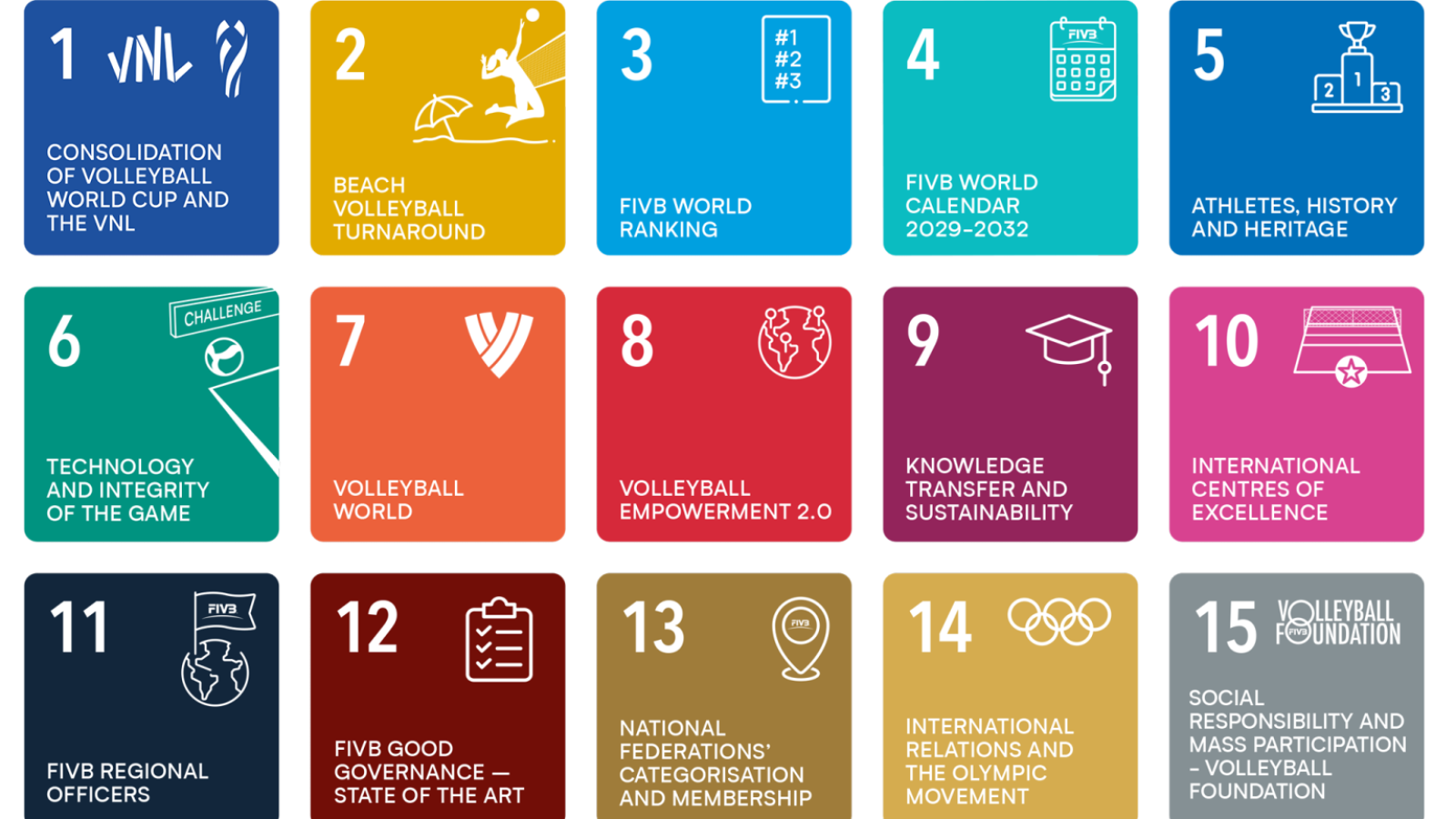
The FIVB said it gathered contributions from national federations and volleyball stakeholders worldwide before defining 15 areas of focus for the years ahead. Those areas are intended to be developed and executed by the FIVB’s boards and commissions, its executive committee and board of administration, with support from professional teams at the FIVB and Volleyball World.
That structure matters when interpreting later news. Strategic Vision 2032 is a shared programme implemented through several bodies, not a single instruction directed at national teams.
Read the ranking changes as decisions
The clearest confirmed changes came from the FIVB Board of Administration meeting held online on 27 February 2026. The board removed the previous minus-50-point penalty from the FIVB world ranking.
At the same meeting, national teams that had never taken part in a competition were allowed to re-enter the ranking with zero points. Events run by zonal associations and recognised volleyball associations received a match-weight factor of 20.
Taken together, these measures change how inactivity, first-time participation and certain association events are represented in the ranking system. They do not show that every part of the ranking method has been replaced or that an entirely new ranking table has been created.
The practical reading is specific: teams previously affected by the penalty now have a different starting condition; teams without prior competition participation can return with zero points; and recognised association events have a defined weighting factor. When checking later ranking updates, look for those conditions in the treatment of the teams or matches concerned.
Keep the Beach World Series in the future category
The FIVB Beach World Series requires a different label. The federation announced plans to launch it in November 2026, with a format built around 10 global sports-and-entertainment destinations. Dubai was confirmed as the founding host.
The November launch and Dubai’s role are announced details. The wider rollout remains a plan until later FIVB reporting confirms that the launch and format were delivered. Do not treat the series as an operating competition solely because it appears within the Strategic Vision 2032 programme.
Test growth claims against activity figures
When the federation refers to “global growth”, compare the ambition with a concrete measure of activity. On 27 February 2026, the FIVB said more than USD 54 million had been invested through nearly 1,700 projects across more than 200 national federations.
This gives a reported measure of the scale of activity behind the roadmap. It does not show how each project performed or how the investment was distributed, so those conclusions require separate evidence.
The FIVB Development Commission reported another measurable result in its review of 21 January 2026: during 2025, 90 development courses were organised by 54 organisers and attended by 2,969 participants.
The federation also said that a national-federation categorisation system tested in 2025 was due to be deployed in 2026 across all 222 national federations. That remains a planned deployment until subsequent reporting establishes whether it reached the full group.
Investment, projects, courses and participants describe delivery and reach. They show that programmes are being run, but they do not alone demonstrate that the 2032 target has already been achieved.
Follow future updates with five checks
According to Fabio Azevedo, the FIVB’s stated ambition is to grow the Global Volleyball Movement to 1.6 billion people. Because that is a long-term objective, progress should be tracked through the mechanisms and results reported along the way.
Check the ranking treatment first: does later reporting continue to reflect the removal of the minus-50-point penalty, zero-point re-entry and the match-weight factor of 20? Then check whether the categorisation system reaches all 222 national federations as planned.
Next, compare development updates with the 2025 figures for organisers, courses and participants. For association events, verify whether the weighting factor of 20 is still defined in practice. Finally, check whether the Beach World Series launches in November 2026 with Dubai as its founding host and the announced format of 10 destinations.
If an update supplies only a new target, keep it in the roadmap category. If it records an approved rule or a completed programme, treat it as implementation evidence. This keeps the ranking decisions and development activity distinct from the future beach series and the wider 2032 ambition.
Strategic Vision 2032 has already produced concrete ranking decisions and reported development activity. The Beach World Series remains a November 2026 plan until delivery is confirmed. The most reliable way to assess the programme is therefore to record what has taken effect, track the announced checkpoints and reserve judgment on the final 2032 outcome until new evidence arrives.