
[Guide] How to Read Mark Stone’s Two-Year, $18 Million Golden Knights Contract
Mark Stone’s new deal keeps him in Vegas for two seasons after the current campaign at a $9 million annual average. Here is how the term, production and missed time shape the decision.
Level: Informed · Reviewed 12 Sep 2026
NHL.com reports that Mark Stone will remain with the Vegas Golden Knights beyond the current season after signing a two-year contract worth $18 million, according to NHL.com’s September 12, 2026 report. The agreement begins next season and carries a $9 million average annual value. To judge it properly, put the shorter commitment beside Stone’s recent production and his availability record.
The contract is shorter and slightly cheaper each year
The terms are straightforward: two years, $18 million in total and $9 million per season on average. Stone is finishing the final season of his previous eight-year, $76 million agreement, which he signed with Vegas on March 8, 2019, at a $9.5 million average annual value.
The new contract therefore lowers the average annual value by $500,000 while cutting the commitment from eight seasons to two. It also removes the possibility of Stone becoming an unrestricted free agent after this season. Vegas has secured its 34-year-old forward for the following two seasons, with a defined end point instead of another long-term obligation.
That shorter term is the clearest benefit for the team. The $9 million annual figure is still substantial, so the question is not simply whether Vegas avoided eight years. It is whether Stone’s contribution over those two seasons is available often enough to support the commitment.
Stone’s recent production supports the investment
Stone’s latest season gives Vegas a strong performance case. He produced 73 points in 60 games, with 28 goals and 45 assists, ranking third among the Golden Knights. In the playoffs, he added 12 points in 17 games, including seven goals and five assists.
The split matters. Stone’s regular-season total came across 60 games, not a full schedule, while his postseason production came over 17 appearances. Those numbers show the level he reached when he was in the lineup; they do not guarantee the same output under the new agreement.
Vegas also reached the Stanley Cup Final last season before losing to the Carolina Hurricanes in six games. That run adds context to Stone’s role with the club, particularly in the postseason, but it cannot predict the team’s next result or turn past production into a future guarantee.
Missed games are part of the value calculation
Stone missed 16 games because of a wrist injury from October 20 through November 24. He later missed five games from March 3 through March 10 because of a lower-body injury.
His postseason availability was uneven as well. An undisclosed injury kept him out of Games 4 through 6 of the Western Conference second round against Anaheim, followed by Games 1 and 2 of the Western Conference Final against Colorado. Stone returned for Game 3 of that conference final and helped Vegas complete a four-game sweep.
Those absences do not erase the production attached to his appearances, but they change how the $9 million annual average should be monitored. The relevant test is the relationship between games played and contribution across the two seasons. If Stone’s high-level production is present regularly, the shorter deal gives Vegas a clearer path to receiving value; if missed time remains a recurring feature, the annual cost becomes harder to defend even though the total term is limited.
His franchise role explains the commitment
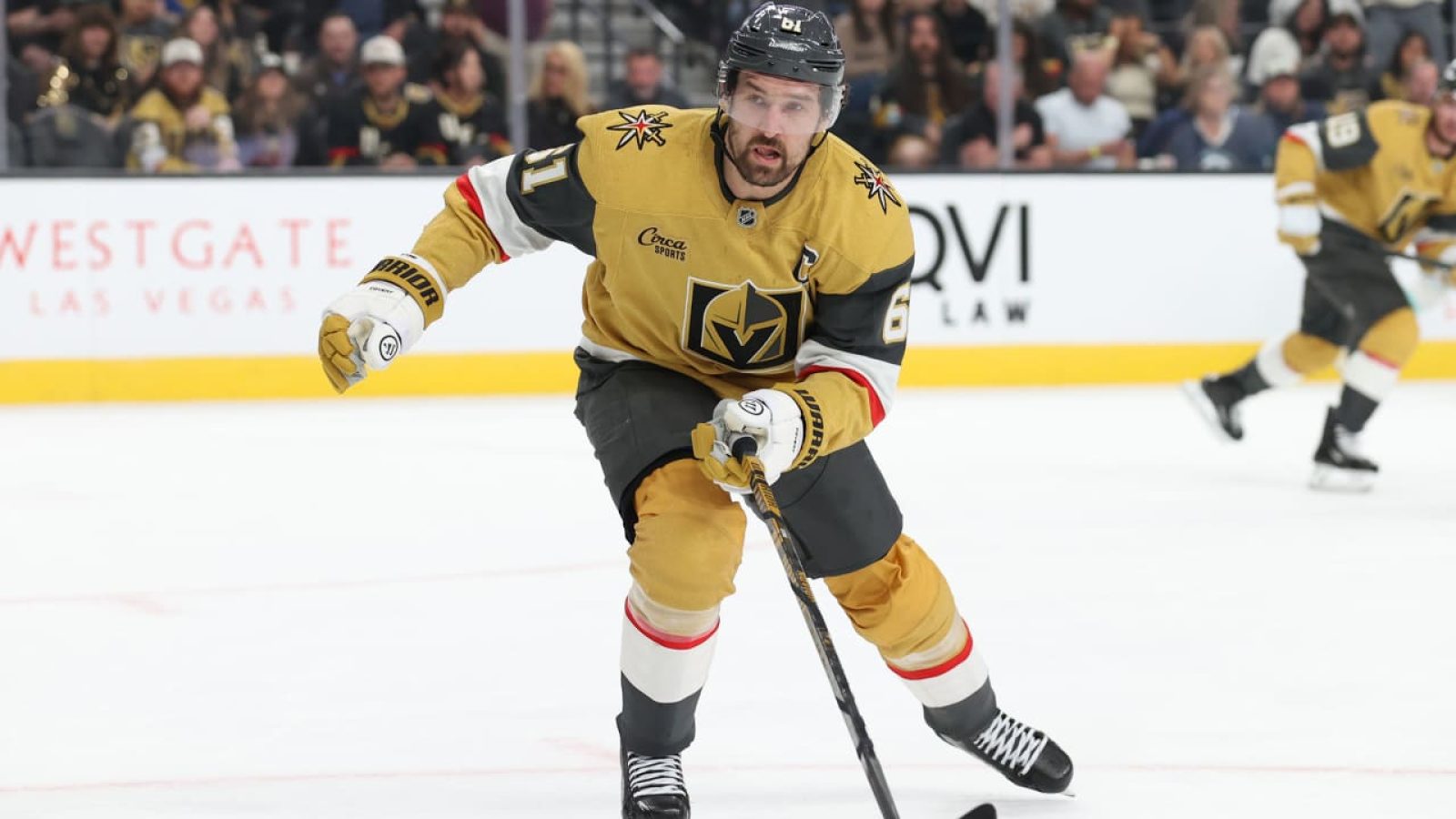
Stone was named the first captain in Golden Knights history on January 13, 2021. NHL.com lists his 84 points in 102 playoff games, including 43 goals and 41 assists, as the highest postseason total in franchise history.
His place in the organization also carries historical weight. NHL.com describes Stone as the first player of the modern NHL era, dating to 1943-44, to help a team win its first Stanley Cup while serving as its first captain. He scored the third hat trick in the decisive 9-3 Game 5 victory over the Florida Panthers.
That record helps explain why Vegas was willing to keep Stone beyond the current campaign. It establishes his importance to the Golden Knights, but it does not settle the separate questions of future health, scoring or team results.
A practical way to judge the deal
- Start with the timeline. The new agreement begins next season and does not replace the final season of Stone’s current contract.
- Use the correct value. The total commitment is $18 million, while the average annual value is $9 million. They describe the same deal from different angles.
- Compare the prior obligation. Stone’s previous agreement covered eight years and $76 million at a $9.5 million average annual value. The new contract is shorter and $500,000 lower per season on an average-annual basis.
- Pair points with appearances. Track the 73 points in 60 regular-season games and the 12 points in 17 playoff games alongside the number of games Stone plays. The production figures are meaningful only when read with their sample sizes.
- Account for the injury record. Include the 16-game wrist-related absence, the five-game lower-body absence and the undisclosed playoff injury when assessing availability. They are part of the risk Vegas is accepting.
- Keep leadership in its proper place. Stone’s captaincy, franchise playoff record and Stanley Cup achievement explain his organizational value. They should inform the context, not serve as a substitute for monitoring his future games played and production.
The decision comes down to availability over two seasons
Vegas is accepting a concentrated risk: a major annual commitment to a 34-year-old forward who has produced at a high level when available, alongside a much shorter obligation than the eight-year agreement that preceded it. The structure protects the team from another extended commitment, but it cannot remove the uncertainty created by Stone’s missed games.
The most useful assessment is concrete. Over the next two seasons, compare Stone’s games played and production with the $9 million annual commitment, using his 73-point, 60-game regular-season sample and 12-point, 17-game playoff sample as context rather than as a promised benchmark. The deal is easier to justify if both the level and the availability hold; the shorter term matters most if they do not.
Stone is signed for two more seasons after the current campaign at $18 million total. Vegas has lowered the annual average slightly and limited the term, but the contract’s outcome will still depend on how often its captain is able to deliver his established level of play.